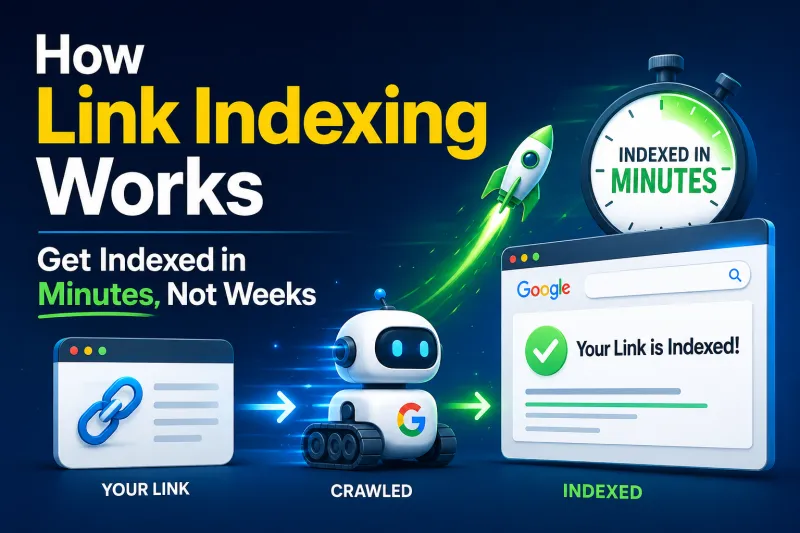
QuickIndexing manages submissions, not Google's index
QuickIndexing helps customers prepare URL batches, reserve submission credits, choose immediate or drip processing and review history. It does not guarantee that Google will crawl, index or rank a page.
This article explains the product workflow, from preparing input to reviewing a recorded outcome. For an educational explanation of search-engine stages, read how link indexing works.
Before a submission
Check the actual page URL, remove exact duplicate rows and exclude pages that are intentionally private. For an owned website, review technical eligibility and Search Console evidence first. For a publisher's backlink page, request a publisher review when you cannot change its restrictions.
Choose a workflow from bulk submission, owned-site URL review or the customer API. Current prices are on the pricing page; this article does not hard-code package amounts.
Prepare one batch from start to finish
- Collect the exact public pages you intend to submit and note whether they belong to you or another publisher.
- Sign in and review the current credit balance and package options before starting a paid submission.
- Paste one URL per line, or choose a TXT or single-column CSV file in the dashboard. Review the unique count and drip options before submitting.
- Keep the input list and submission time so you can identify the batch in History.
- Review the recorded processing outcome, then assess search-engine evidence separately.
The batch preparation guide explains supported inputs and duplicate handling. If an owned page is inaccessible or has an unintended indexing restriction, fix that issue before paying for another submission.
How credits and schedules fit together
One credit covers one valid unique URL submission. Exact duplicate rows within a text/API batch are deduplicated; repeating a URL in a separate intentional request can charge again. Drip submissions reserve credits for the eligible URLs before scheduled processing.
A drip interval controls QuickIndexing's processing schedule. It does not control Google's crawl schedule, establish a natural backlink pattern or certify an SEO benefit. Read the drip guide before enabling it.
For example, a list containing the same valid URL twice plus one different valid URL has two unique URLs within that request. A later intentional submission of the same URLs is separate work and can charge again. This is an input-handling example, not a customer balance or indexing result.
What to expect in History
| Record | Interpretation |
|---|---|
| Drip Scheduled | Future work is scheduled; a due time is not proof of completion. |
| Pending | The workflow has no final recorded outcome yet. |
| Submitted | A submitted processing outcome is recorded, without independently certifying Google indexing. |
| Rejected | A rejected outcome is recorded; review the explanation rather than treating it as a Google penalty. |
Handle uncertainty before sending another batch
Keep the time, the affected URL list and a request ID when available. Check History or contact support if the outcome is uncertain. An API integration should retain its exact payload and idempotency key for safe replay, following the documented rules, rather than generating a new key after an ambiguous response.
For new integrations, keep the key on your backend and use the API authentication, request limits and error reference. The customer API accepts up to 100 URLs per request. A successful HTTP response and the submitted, pending or scheduled counts should be interpreted according to that contract; they are not Google index-status fields.
The unused-credit refund policy describes existing eligibility. It is not a guarantee that any submission will be indexed or a promise of an automatic refund for every Google exclusion.
Measure the right outcome
Use processing records for operational reporting and appropriate search-engine tools for indexing evidence. Keep ranking and traffic measurements separate again. Illustrative examples and synthetic screenshots are not customer case studies or success-rate measurements.
For external publisher URLs, follow the backlink indexing evidence checklist. For an owned page missing from expected search results, use the website visibility diagnostic guide. Neither check should be replaced with repeated paid submissions.
Google's public Indexing API has its own restricted content eligibility. QuickIndexing's customer API is a different integration and does not grant general eligibility for that Google interface.
Questions about a particular record belong with support. Keep passwords and API keys out of your message.
Questions before buying or repeating a batch
Is one credit a guaranteed indexed page?
No. A credit pays for a URL submission. Compare the current credit packages and costs with the workflow you need, rather than assuming a guaranteed Google result.
Should I resend a Pending batch?
Review History and contact support when necessary. An uncertain processing outcome is not evidence that nothing was sent; a new intentional request can create another charge.
Does Rejected mean Google penalized my website?
No. It describes a recorded workflow outcome. Review the available explanation and the affected URLs before drawing a conclusion about search visibility.
By QuickIndexing. Reviewed 27 October 2026.